


There is no list price for a private jet, and any broker who gives you one before asking about your trip is guessing. The same aircraft on the same route can be quoted at two different numbers a week apart, and the reason is almost never the aircraft — it is where the aircraft is, who is flying it, what the airports charge, and what is happening in the wider market that week. This page explains how a charter quote for Asia is actually built, component by component, so you can read a quote properly and know which parts are movable.
ASA Air Charter is an independent broker. “The ASA Group and its subsidiaries act solely as air charter brokers and do not own, maintain, or operate any aircraft.” That matters for pricing: because we are not selling a fleet we have to keep flying, we compare the market of licensed operators and put the aircraft that fits the mission in front of you, rather than the one that needs the hours. ASA was founded in 1999 by Simon P. Wagstaff BEM MIExpE and has offices in Hong Kong, Thailand, Malaysia, Indonesia, Singapore and the Philippines.
Why we quote live rather than publish a price list
Charter pricing is not stable enough to publish honestly. It moves with the season, with demand across the region, with fuel, and with events well outside aviation — airspace closures, political disruption and weather all reprice a route at short notice. A figure published in one quarter can be materially wrong in the next, and a client who plans around it has been misled rather than helped.
So instead of a rate card, we go to the market for your specific trip and come back with what it actually costs on your dates. ASA provides live market quotes. The rest of this page is about what sits inside that number.
Two identical-looking requests can differ substantially in price without anything unusual happening. The largest reason is positioning — where the aircraft has to come from to reach you. The second is the day and time you want to depart. Everything else on this page is smaller, but it compounds.
How a charter quote is built
A charter price is not one number with a margin on it. It is a stack of separate costs, some attached to the aircraft and some to the route and the airports. This is the full stack, in roughly the order it lands on the quote.
1. The aircraft category
Every quote starts with an hourly rate attached to the aircraft class, multiplied by the block time of the flight. Each step up a category adds materially to that hourly figure — the jump from light to midsize, or midsize to super-midsize, is a real one rather than a marginal increase.
What each category buys you, and where it makes sense in Asia:

| Category | What it gives you | Typical use in Asia |
|---|---|---|
| Turboprop | Short-field access and efficiency over short sectors | Island and regional hops, unpaved or short runways |
| Very light jet | Jet speed on short sectors, small cabin | One to two hour hops, small parties |
| Light jet | The regional workhorse — comfortable for six or seven | Singapore–Bangkok, Bangkok–Phuket, KL–Singapore |
| Midsize jet | More cabin and baggage, longer legs | Regional business travel with a full cabin |
| Super-midsize jet | Stand-up cabin, longer range | Longer regional sectors, multi-sector days |
| Heavy / large jet | Long-haul capability and a full cabin | Asia to the Middle East, Australia, North Asia |
| Ultra-long-range jet | Non-stop intercontinental range | Asia to Europe or the Americas without a fuel stop |
| VIP airliner | Group capacity with a private cabin | Large delegations and full-team movements |
| Helicopter | Point-to-point access without a runway | Resort, offshore and city transfers |
The practical point is not which category is cheapest. Give the real passenger and baggage count and let the broker size the aircraft to the mission.
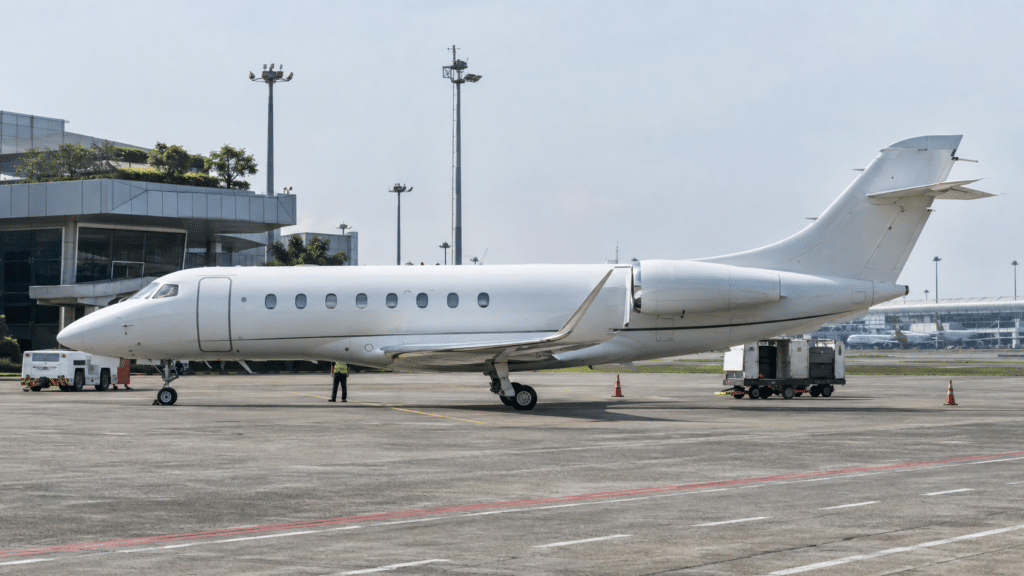
2. Positioning — the cost you cannot see on a timetable
An airliner is already at the airport because a schedule put it there. A charter aircraft is wherever its last trip left it or returned to its homebase. If the right aircraft for your mission is in Kuala Lumpur and you are departing Bangkok, somebody pays for it to fly to Bangkok empty, and for it to go home or on to its next job afterwards.
On a one-way request, positioning is frequently the largest single element of the quote — larger than any airport charge and sometimes rivalling the billed flying itself. It explains three things that otherwise look arbitrary: why a return trip is rarely double a one-way, why the same route prices differently on different days, and why moving a departure by a day can change the number more than changing the aircraft does.
3. Crew duty time and overnight costs
Crew are bound by regulated duty and rest limits. If your itinerary pushes past them, the operator must either night-stop the crew or carry a second crew — and a second crew is a step change in cost, not an increment. Crew hotel and subsistence costs are charged on top, along with aircraft parking for the night.
The effect is not intuitive: a same-day return that lands back late in the evening can be materially cheaper than one landing shortly after the duty limit. It is worth asking whether the schedule you want sits inside or outside the limit, because a small change to a meeting time occasionally moves a large number.
4. Landing, handling and parking
Landing fees scale with aircraft weight and vary enormously by airport, with major international hubs at the top of the range and heavy aircraft well beyond it. Ground handling and ramp fees vary the same way. In Singapore, handling at Seletar is consistently cheaper than at Changi.
Parking is a real cost in Asia, not a rounding error. Overnight and multi-day parking at slot-constrained fields is charged, and at some airports it forces the aircraft to reposition to a remote stand.
ASA arranges this side directly: “We broker optimal airport slots and arrange aircraft parking at key regional airports” and “We arrange on-site supervision for every arrival and departure.”
5. Permits, overflight and navigation charges
Asia is not one airspace. A Singapore–Bangkok flight crosses Malaysian airspace; a Hong Kong–Jakarta flight crosses several jurisdictions, each with its own navigation charge and, for non-scheduled flights, its own permit process. Routings that cross more borders, or more restrictive ones, cost more and take longer to clear.
ASA handles this as part of the service: “We obtain fast-track approvals for scheduled and non-scheduled flights” and “We secure clearance for transit through controlled airspace via our aviation authority network.” Standard landing permit processing is published on our ground handling page as 24–72 hours, with urgent permits expedited where possible.
6. Fuel
Most operators fold a fuel surcharge into the hourly rate and adjust it as the market moves, which is one of the main reasons charter pricing is not stable from quarter to quarter. Fuel price also varies by field — at Singapore, fuel is cheaper at Changi than at Seletar because of airline volume, while handling runs the other way. Which field is cheaper overall depends on the trip.
7. Catering, connectivity and cabin extras
Basic catering is normally included by aircraft class. Anything specified beyond that is charged. In Indonesia, 24 hours’ notice is required for catering and options at smaller fields are limited. Cabin connectivity is billed by the aircraft’s system — older aircraft can charge by data used, newer ones by flight.
8. Minimum daily hours and short-leg charges
Most operators apply a daily minimum — a floor on billed flight time for each day the aircraft is committed to you. A short hop is therefore often billed at that minimum, and an aircraft sitting on the ground for you between legs still accrues charges. Some operators also apply a short-leg or cycle fee, because frequent take-offs and landings drive maintenance faster than flight hours do.
This is the most common surprise for first-time charterers, and it is why a multi-stop day is not priced as the sum of its flying times.
9. Slots, curfews and out-of-hours operations
Slot-coordinated airports add cost and remove flexibility. Every airport is slot-coordinated. Singapore Changi requires slots and, in business aviation terms, they are hard to get.
Departing outside an airport’s standard hours, where it is permitted at all, is charged separately and is not cheap.
10. Tax and duties
Tax treatment differs by jurisdiction and by how the flight is structured. Some apply GST and others apply VAT. Some even apply luxury-goods rates to private jets specifically.
Rates and reliefs change, and whether a particular charter attracts tax depends on how the supply is structured. ASA is not a tax adviser and does not give tax advice — confirm your position with your own adviser before committing.
What is usually in the price, and what is not
- The aircraft, crew and standard fuel surcharge
- Insurance
- Standard catering for the aircraft class
- Routine landing and handling on the quoted routing
- Positioning, where the quote is stated as all-in
- Out-of-hours airport opening
- Specified catering above the standard cabin offer
- De-icing
- Itinerary changes after confirmation, and any permit reprocessing they trigger
- Government taxes, where not already included
Quotes are not written to one standard. The practical question to ask any broker is not “how much” but “what is in this number and what is not” — two quotes that look far apart are often the same trip described differently.
Live market quotes from licensed operators, normally within two hours — with a clear statement of what is inside the number.
Five levers that genuinely move the price
None of these involve accepting a less safe aircraft or a less capable operator. They are all about matching the mission to what the market already has in the right place.
Flex the date or the hour.
Positioning is the biggest single variable. A departure that suits an aircraft already in the region is a different price from one that requires an aircraft to be flown in.
Right-size the aircraft.
Tell the broker the real passenger and baggage count, not a comfortable maximum. Cabin volume nobody uses is the easiest money to stop spending.
Choose the departure field deliberately.
Seletar versus Changi, Don Mueang versus Suvarnabhumi, Halim versus Soekarno-Hatta — the business aviation field is usually faster and cheaper on handling, and the difference is not marginal.
Consolidate legs.
Daily minimums mean a tightly planned two-sector day often costs little more than one sector. Spreading the same flying across three days rarely does.
Give the charter desk more notice.
Notice is what lets a broker work the market instead of taking what is left. It is also what keeps permits and approvals off the critical path.
We prefer a week’s notice before the departure date to ensure all permits and approvals are in hand. If you need to fly sooner, contact our charter team and we will check whether it is operationally viable at short notice.
How ASA prices a charter
We are a broker, so our job is to read the market on your behalf and then hold the operator to the trip. In practice:
- We take the real mission — passengers, baggage, timings, the airports that actually work for you, and what the day either side of the flight looks like.
- We compare the market of licensed operators rather than a single fleet, and return live market quotes.
- Before any aircraft is put forward, we check the operator’s documents (see below).
- We manage permits, overflight approvals, customs clearance and ground handling on your behalf, and act as one accountable point of contact.
- Our charter specialists are available 24/7.

What we check before an aircraft is offered
Price means nothing if the operator behind it is not in order. Before we put any operator forward for a mission we require:
- An in-date AOC (Air Operator’s Certificate) — the official approval from a country’s civil aviation authority permitting the company to run commercial flights carrying passengers or cargo.
- A COI (Certificate of Insurance) verifying the aircraft is fully covered financially for the specified mission.
- For helicopter missions, the AOC Operations Specifications, which state the approvals held for different kinds of aerial work.
- Validity of FAOC/FOP where the routing requires it — the approvals that allow a foreign operator to land and take off in specified countries.
Private jet charter cost in Asia — frequently asked questions
It depends far more on the routing, the timing and where the aircraft is starting from than on the aircraft alone. We do not publish a rate card, because charter pricing moves with season, demand, fuel and events outside aviation — a published figure would be wrong often enough to be misleading. Tell us the trip and we will quote it live, normally within two hours, and set out what is inside the number.
Because a number given without the details is a guess, and a guess you plan around is worse than no number at all. The details that change the price most are the ones a rate card cannot know: where the nearest suitable aircraft is, what your timings do to crew duty limits, which airports you can use, and what permits the routing needs.
Because the aircraft still has to get to you and still has to go somewhere afterwards. On a one-way request, the empty positioning flights either side are usually the largest single element of the quote. A return trip spreads that same positioning cost across more billable flying, which is why it often looks like better value per hour.
It varies by broker and by operator, which is the most common cause of confusion when comparing quotes. Ask specifically whether positioning, landing and handling fees, crew overnight costs, catering and government taxes are inside the figure. ASA states what is in the quote when we issue it.
Most operators require a minimum amount of billed flight time for each day the aircraft is committed to you. If your aircraft waits on the ground between two short sectors, it is unavailable to anyone else that day, and the minimum reflects that. Planning legs closer together is usually cheaper than spreading them out.
Usually, yes — and it is faster. Handling at Seletar is cheaper than at Changi; Don Mueang is the established business aviation field in Bangkok; Halim is Jakarta’s. The saving is on handling and turnaround rather than on the aircraft, but the time saved is often the bigger benefit.
We prefer at least a week’s notice before the departure date to ensure all permits and approvals are in hand. If you need to fly sooner, contact our charter team and we will check whether it is operationally viable at short notice. Notice is not only about permits. It is what allows us to work the market properly rather than price whatever is still free.
ASA acts solely as an air charter broker and does not own, maintain or operate aircraft. Ask us how the quote is structured and we will tell you plainly — a broker who will not answer that question is telling you something.
Request Your Private Jet Charter Quote
Tell us your travel details and our charter experts will source the ideal aircraft, pricing, and availability—tailored to your schedule, anywhere in the world.